In today’s world, a point-of-sale (POS) system needs to do more than just ring up sales. Traditional cash registers just don’t cut it. Instead, to make the most of sales and further customer relationships, businesses must use a multifaceted POS system capable of not just payment processing but also inventory management, customer management, employee management, mobile accessibility and more.
The best POS systems on the market, such as Clover and Square, help retailers, restaurants, hospitality businesses and other enterprises launch and maintain loyalty programs, schedule worker shifts, track stock levels, and streamline operations through integrations with other business software. Some of the top solutions we found also have e-commerce abilities and all boast strong analytics tools for monitoring performance and making sales forecasts. Simply put, with the right POS system, a business can drive sales and growth. After careful research and testing, our top recommendations hit all these beats and more.
The POS market is crowded, with many vendors trying to differentiate their features and services to remain competitive. Here are a couple of things to consider when choosing a POS system.
Pricing
Some POS vendors sell software only, while others sell software and hardware. When it comes to payment processing, some POS providers include that with their bundled packages, while others don’t offer it at all. Because of all this, making an apples-to-apples comparison when shopping for a POS can be challenging. Include the costs for all three components (software, hardware and payment processing) in your calculations when evaluating your options.
Features
Each POS system offers a different mix of features based on the service plan you choose. Many systems are customizable, allowing you to add hardware and software programs for an extra cost. As you evaluate systems, decide which features you need to calculate the total cost, including add-ons. Depending on your business, some features you should consider are:
- Invoicing
- Multilocation management
- Inventory and order management
- Sales reporting
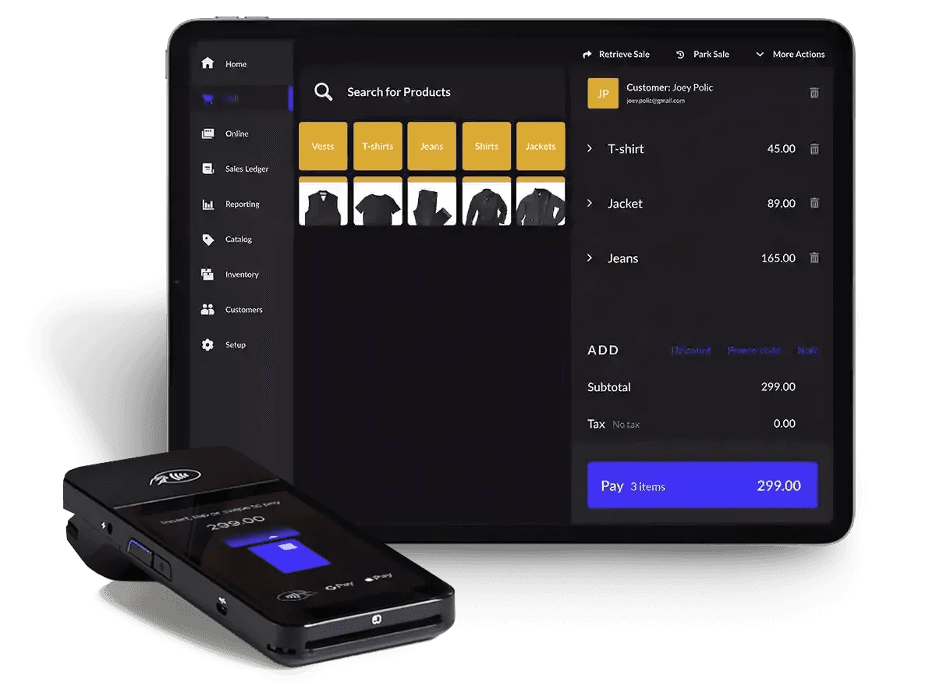
While businesses will have a monthly subscription fee for the POS software, their upfront costs will vary based on their chosen hardware. Source: Lightspeed
Advancements in technology and a reduction in point-of-sale hardware and software prices have widened the market for POS systems for all types and sizes of businesses. Hardware no longer costs several thousand dollars, and the service contracts aren’t hundreds of dollars per month. Today, there are price points to fit one-shop merchants as well as retailers with several locations and e-commerce businesses.
There are three components to consider when determining the price of a POS solution: hardware, software and payment processing. POS system costs vary depending on the hardware and software features you need, as well as the payment processor you use. You’ll want to do some comparison shopping to ensure your chosen POS system will cater to all your needs. Monthly software subscription costs can range from $0 to over $200 for systems with cloud-based functionality. With select vendors, some hardware is complimentary, while others charge as much as $1,200 for a robust POS register system.
POS Hardware Costs
There are a variety of POS hardware options that will impact your costs. Depending on the business, a POS system may need a terminal, tablet or computer; a cash drawer; a card reader; barcode scanners; a receipt printer; and signature-capture devices. The best POS systems are compatible with third-party hardware, letting you shop around for deals (and continue using your chosen hardware if you switch software providers later). They’re also scalable, allowing you to start small with a single terminal and add peripherals as your business and budget expand.
For small businesses with basic needs primarily revolving around accepting credit card payments, a phone or tablet and a card reader will suffice. If you already have mobile devices and only require EMV-compliant and an NFC-enabled credit card reader, this setup usually ranges from $20 to $100. [Learn why restaurant businesses should use tables .]
Most small businesses will want a variety of accessories, such as a tablet stand, cash drawer and receipt printer. For this type of setup (using your own tablet), you’ll typically pay between $600 and $1,200. Additional hardware like barcode scanners, kitchen printers and display screens cost extra.
POS hardware typically costs $20 to $1,000, depending on what you need. Peripherals such as barcode scanners and display screens will add to your expenses.
POS Software Costs
The cost of POS software largely depends on the services you need. You could pay anywhere between $25 and $300 per month for a POS software plan. Monthly subscriptions are the most common payment model in the POS world.
Most cloud-based POS vendors have pricing tiers with different features. Some packages limit the number of users or the monthly sales volume you can process. Some POS companies like Toast provide free POS software, but there’s a catch: You must process your payments through them instead of a third-party processor.
If you want a basic, free POS system, the best options are from highly rated mobile credit card processors, such as Square. These credit card processing companies include POS features in their mobile processing apps. You must use the same provider for your payment processing in order to use its POS app, but you aren’t locked into a long-term contract. Processing fees are charged on a pay-as-you-go basis, which is ideal for very small businesses.
If you need more out of your POS software, such as inventory management, e-commerce or employee scheduling tools, expect to pay $40 to $100 per month. The more bells and whistles you want, the higher the monthly cost will be. Whether you get an industry-specific plan, like those offered by Clover and Lightspeed, will also affect your software expenses.
When shopping for a POS system, be mindful of the features in each tier: One company might include all of the tools you need in its basic package, whereas you may have to pay for a higher tier to access some of those same features with another vendor. For example, inventory management with tracking capabilities may be standard in all packages with one company and an add-on with another.
Before deciding on a POS system, get a full demonstration of the software you’re interested in. Some vendors offer self-guided demos while others employ sales representatives and product specialists who can show you how the platform works.
Payment Processing
The final piece of the POS pricing puzzle is payment processing. This is the cost to accept and process customers’ payments through your POS device. These involve transaction fees for card-present, card-not-present and keyed-in credit card payments. Rates typically vary by processor.
The best POS vendors provide you with a choice of payment processors, giving you the opportunity to shop around for low rates and affordable fees. This means you won’t have to switch out your entire POS system if you decide to use a different processor. [Check out our recommendations for the best credit card processors .]
However, some POS providers are increasingly offering in-house processing, which can be convenient but more costly in the long run. Some give you a choice to use their in-house processing service, while others charge an extra fee (either monthly or per transaction) for using a compatible third-party processor. Notably, Clover and Square require you to use their in-house credit card processing service exclusively. __
The average credit card processing fee ranges from 1.3% to 3.5% per transaction.
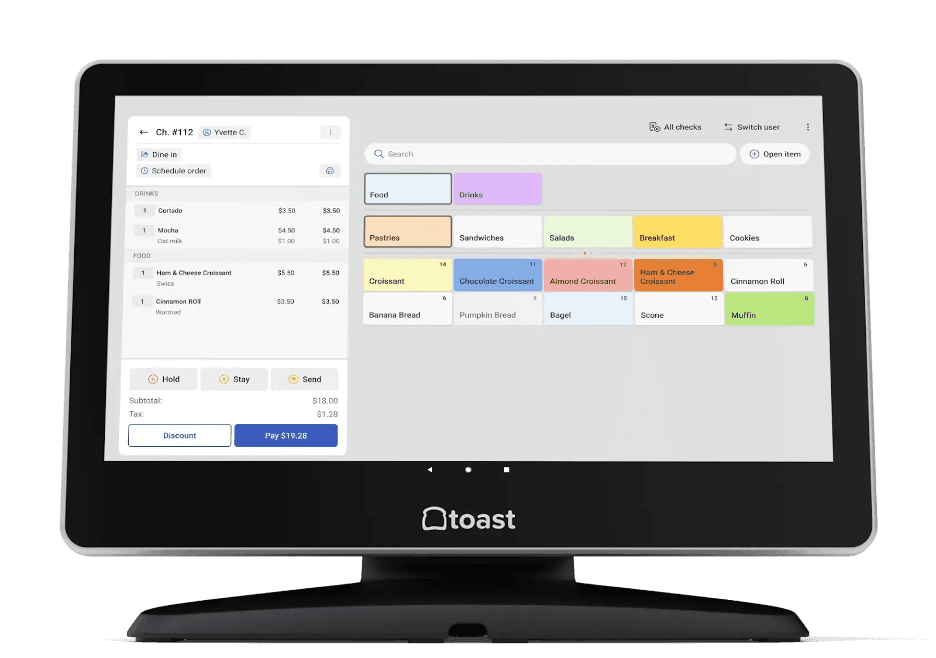
While most POS systems have the same basic functionality, industry-focused solutions like those offered by Toast (for food and beverage businesses) include specific features and tools designed for the business type. Source: Toast
POS systems can have hundreds of features, but they’re meaningless if you don’t use any of them. While some businesses may require a full arsenal of point-of-sale tools and features, others may prefer to keep things simple. As you look for POS software, think about what your business needs, the functionality that would be nice to have and which features you’ll never end up using.
Besides the basic cash register features that every POS solution has, look more closely at each platform’s unique feature set before selecting a system. Keep in mind that specific capabilities within each feature set vary by system and by plan. Advanced features may be available only at higher service tiers, or you may need to add apps or software integrations to the POS system to augment its functionality.
Below are the standard software features you should look for when shopping for a POS system.
Mobile App Support
The best POS systems come with apps that are installed on tablets and smartphones, transforming the devices into mobile POS (mPOS) terminals. Retailers can use them as mobile checkout devices to ring up customer orders anywhere on the store floor, while restaurants can use them to take orders and accept tableside payments. You can also attach a tablet to a stand and turn it into a stationary kiosk. From there, you can add peripherals, such as a cash drawer and a receipt printer, to create a countertop checkout station.
When comparison shopping, be mindful of the operating system the mobile POS supports. Although some POS solutions can be used with both Android and iOS devices, some — like Toast and TouchBistro— are specific to one or the other. If you have a strong preference for one operating system or already have tablets and phones you want to use, this is an important consideration. If you’re looking for a dual-platform POS system, check out vendors like Clover and Lightspeed.
- iPad mPOS: iPads are the preferred platform for most POS providers. These Apple devices are known for their user-friendly interface and stability. iPads also have superior security due to the closed nature of Apple’s iOS. That makes it harder for hackers to install malware on the devices. But you will pay for that security, as iPads tend to be more expensive than Android-based POS systems. Popular iPad POS systems include TouchBistro and Revel.
- Android mPOS: While iOS-based systems are more common, systems using Androids tend to be less expensive. With multiple manufacturers, there’s more competition in the market, resulting in lower prices and broader product selections. That can save you money as you set up your system, add devices or replace broken, lost or stolen tablets. Restaurants seeking an Android-compatible solution should consider Toast.
Did You Know?: With over 2.5 billion devices in use, Android has roughly 70 percent of the mobile OS market share worldwide, according to StatCounter. However, most users prefer iOS when choosing a mobile POS system.
Inventory Management
If you want to keep track of your inventory and orders, a POS inventory management module does a lot of the work for you. When considering inventory management tools, think about what you really need.
- Do you need a basic product catalog or menu-item countdown?
- Do you need to track quantities, including components or ingredients?
- Do you need low-stock alerts or automatic reordering?
If you have a retail business, estimate how many SKUs you need the POS system to support. Some vendors support a limited number of SKUs, and others offer unlimited packages. If you do need advanced inventory management features and they’re not available in the POS system you want, make sure the POS system integrates with the third-party inventory software you plan to use.
Customer Management and Loyalty Programs
Customer retention is an important part of running a store or restaurant. Many POS systems have built-in tools and features to help you manage and retain your customers, but you may not want all the customer management and loyalty program features some POS vendors offer. That’s why, again, it’s important to consider your needs.
If your business needs to collect customers’ payment and delivery information only, you won’t need a built-in CRM. But if you’re looking to create customer profiles with detailed purchase histories and to add notes (such as customers’ birthdays, preferences or allergies), then you want a more robust system. In that case, you might want to look into Square, Lightspeed and TouchBistro.
Employee Management
If your employees are going to be using the POS system, you need to control the data and functions they can access. For example, you may want only your store managers to handle refunds. It’s important to choose a POS vendor that can deliver on your employee management requirements, whether they’re simple or complex. Here are some things to consider with employee management functionality.
- Do you want to set permissions for individual users?
- Do you want to create shift-based schedules through your POS software?
- Do you need a time clock for employees?
- If you’re already using top time and attendance software, will it integrate with your preferred POS system?
Reporting
The reporting and analytics functionality built into POS systems is a huge benefit for businesses. Because the software tracks all of your sales, you get an overview of what inventory is moving and what isn’t. This can help you identify sales trends and ultimately boost your bottom line.
All POS systems can generate reports, but the number of reports, specific report types and customization options differ between systems. Some POS systems offer a much deeper look into sales data, while others give only a surface glance. The more advanced reporting you need, the more you’ll pay for the capability. If you’re a company that requires detailed reports, Clover is a good POS system to consider.
Integrations
Most web-based POS systems have integrations or apps that make it easier for you to share data between the various business software solutions you use. For example, connecting highly rated accounting software to your POS system saves you the time of exporting sales data. Integrating with your e-commerce platform will ensure accurate inventory across sales channels. Look for a POS system that integrates with the business programs your company already relies on, such as accounting software, payroll services, e-commerce platforms and email marketing services.
The best POS systems boast native integrations for a seamless technology experience. Some vendors have marketplaces loaded with hundreds of compatible third-party apps that can streamline your operations. Others have open APIs that allow you to develop your own integrations.
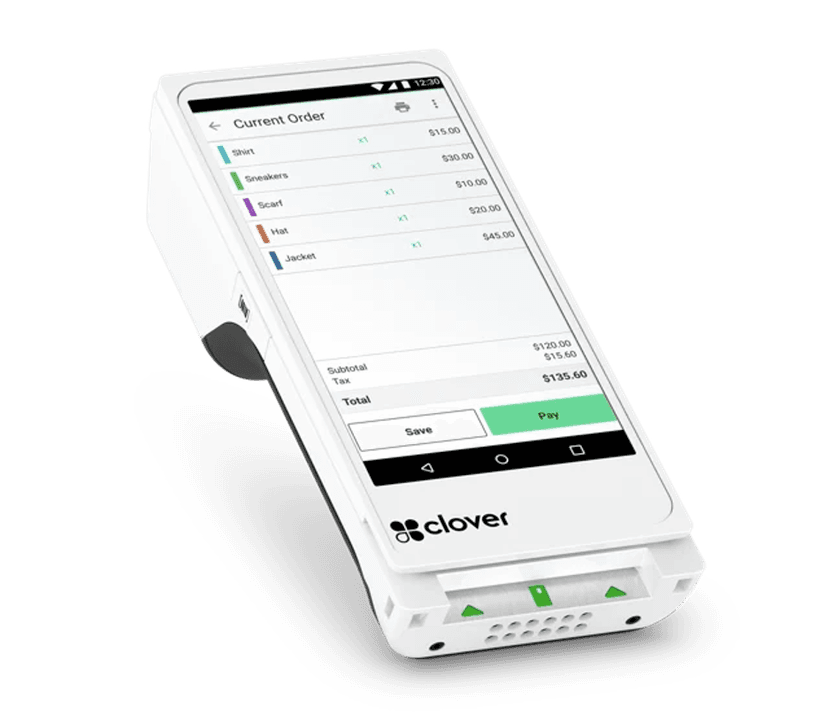
The Clover Flex is a portable, handheld device for tableside orders and payments, although it can be used at other locales as well. Source: Clover
You have a lot of options when it comes to POS hardware and how you configure your system. A basic POS station has a tablet or touchscreen, a credit card reader, a cash drawer and till, and a receipt printer. Some POS systems are compatible with additional peripherals, like the accessories listed below.
- Tablet stand: This holds your tablet in place.
- Barcode scanner: This makes it faster to enter items into the system at the checkout station.
- Scales: These allow you to sell bulk items by weight.
- Customer display screen: This shows the customer their sales ticket as you enter items into the system.
- Kiosk: Customers can use a kiosk tablet to place their own orders.
- Digital menu boards: These are large screens that display your menu and promotions.
- Kitchen printer: This sends orders to the kitchen for the cooks to prepare.
- Kitchen display system: This is a digital alternative to the kitchen printer, showcasing orders on a screen.
- Coin dispenser: This reduces errors and speeds up the checkout process by automatically returning change to the customer.
- Caller ID device: This enables the system to automatically start an order when customers call your business.
Consider which of these hardware technology options your business will need.
Buying, Leasing and ‘Free’ POS Hardware
It’s always best to purchase your POS terminal upfront, even if that means starting with just the basics. You could pay much more than the equipment is worth if you lease it — not to mention that leases have noncancelable, multiyear contracts. Even if you go out of business and return the equipment, you must continue making lease payments until your contract expires.
Some companies offer “free” POS terminals, but accepting these can also be more expensive than buying equipment outright. To get this deal, you typically have to sign a lengthy contract for the company’s credit card processing service, and there’s a monthly fee on top of that for maintenance or insurance. If it’s a “free placement program,” you’ll be required to return the equipment if you close your account when your service agreement expires.
A few vendors, like Clover, allow you to pay for equipment in monthly installments, although that may be more costly in the long term.
Proprietary vs. Open-Source POS Hardware
Proprietary POS hardware works only with the system you’re purchasing it for, so it’ll be unusable if you change systems. Because the hardware is system-specific, you can’t use the hardware if you want to switch to a new system.
Open-source POS hardware can be used with multiple POS systems. If you switch to new POS software that supports open-source hardware, you might be able to continue using the equipment you already own. It’s usually available from the POS company and multiple third-party vendors, enabling you to do some comparison shopping. Open-source hardware offers a little more flexibility to users, especially to ones who are familiar with the technicalities involved. Clover is an example of a company that provides its hardware to other vendors.
Credit Card Terminal or Card Reader
Most of the time, you’ll buy a credit card terminal or mobile reader from your payment processing company. However, sometimes you must purchase it from the POS company you sign up with. Whether you buy it from the processor or POS vendor, you want it to be EMV-certified so you can accept chip cards at your point of sale. You also want it to have NFC capabilities so you can accept contactless payments like Apple Pay, Google Pay and Samsung Pay. For companies that don’t accept in-person payments, you can get by without purchasing a card reader, but you’ll still need a payment gateway so customers can complete transactions.
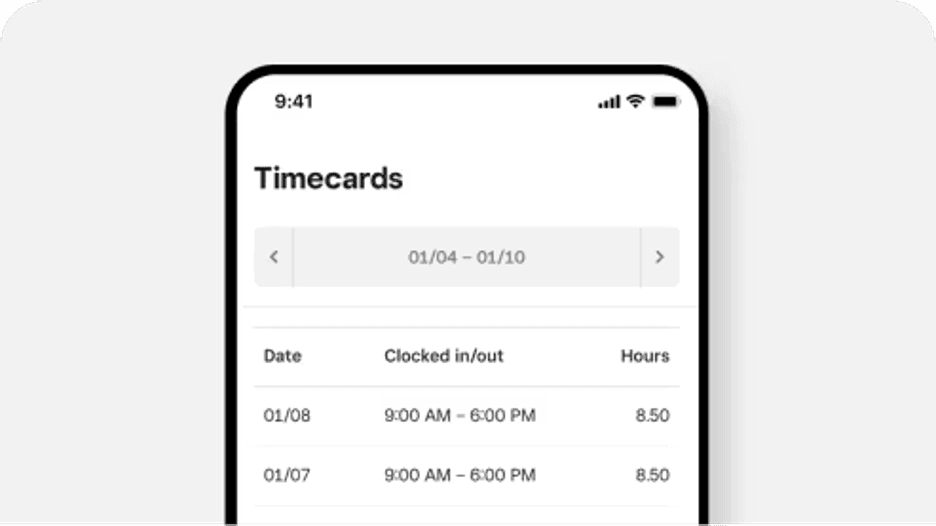
Businesses need to consider whether they want their POS software to include scheduling and timekeeping tools like those offered by Square or if they rather use a standalone time and attendance system. Source: Square
To choose a POS system for your business, follow a few basic steps. Start by making a list of your feature needs and determining your budget. Then, search for systems that include your desired tools at a price point you can afford. Take advantage of demos and free trials to test the platform and read user reviews to gauge customer satisfaction. Compare your test experiences and price quotes from vendors to narrow down your options to the best solution for your business.
As you move through the decision-making process, the top two factors to keep in mind are pricing and features.
Pricing
Some POS vendors sell software only, while others sell software and hardware. When it comes to payment processing, some POS providers include that with their bundled packages, while others don’t offer it at all. Because of all this, making an apples-to-apples comparison when shopping for a POS can be challenging. Include the costs for all three components (software, hardware and payment processing) in your calculations when evaluating your options.
Features
Each POS system offers a different mix of features based on the service plan you choose. Many systems are customizable, allowing you to add hardware and software programs for an extra cost. As you evaluate systems, decide which features you need to calculate the total cost, including add-ons. You want to get the most bang for your buck, so your buying journey should focus on identifying the systems that provide the most value at a reasonable cost.
Be sure to read through all contract terms before signing any service agreement.
While we’re confident our top picks above will meet your company’s point-of-sale needs, the additional POS systems we examined below are alternative options that also have notable selling points.
Lavu
If you’re looking for a restaurant-specific POS system with lots of flexibility, the iPad-based Lavu platform comes packed with more than 200 customizable POS features and tools so businesses of any size can customize a plan to fit their needs. Lavu also rises above its competitors with its add-on features and services; it has nearly 15 in-house integrations that you can add to its POS offering, making it easy to expand your setup. Few competitors offer this many native integrations to support their POS systems. You can also integrate the software with several third-party apps to tailor the system to your needs. Learn more about Lavu.
Helcim
With a rate guarantee and processing fees that are better than those of its rivals, Helcim is one of the best POS solutions if you’re concerned about payment processing. Helcim is a payment processor first and foremost, but it offers an application that operates as a POS system on any device, including computers, tablets and smartphones. Like Clover, Helcim is an all-in-one platform providing merchants with various payment and billing methods, and we also like that merchants can take advantage of a free online store as part of their plan for no additional cost. Helcim takes a no-frills approach, so you get all of the features with a single interchange-plus rate and don’t have to worry about a monthly fee. Read our review of Helcim for more details or visit the Helcim website.
GoDaddy
Similar to Shopify, GoDaddy offers comprehensive POS and e-commerce functionality, making it ideal for businesses geared toward in-person and online sales. Some GoDaddy e-commerce features and tools that we didn’t find in many POS competitors include website design templates, custom domain connections, website security (SSL) and online store creation. We like that you can list thousands of products online, automatically sync your inventory across various locations (e.g., Amazon, Etsy, social media sites) and manage your inventory from a single dashboard. You can also take advantage of marketplace and social selling tools. See a breakdown of plan options in our full GoDaddy review.
CardConnect
CardConnect shines in offering secure payment processing services. CardConnect works closely with Fiserv in order to provide its customers with top POS products, including those offered by Clover. CardConnect can supply your business with high-quality countertop terminals that provide support for both EMV and NFC mobile payment methods, like Apple Pay. We also like how CardConnect allows you to set up hosted payment pages to receive payments or donations online. You don’t have to know any complex programming languages to get started, and there’s no charge for using its primary system, CardPointe.
ePOSNow
Epos Now serves businesses in retail and hospitality with POS software to fit each industry’s specific needs. It offers numerous hardware options and great compatibility between devices, including touchscreen POS systems, iPads, Samsung tablets, a mobile POS called Epos Pocket, receipt printers and cash drawers. The Epos Now software is rich in features and easily scalable, which is excellent for growing businesses that want to start with a simple POS solution and then expand it. It can integrate with credit card processors and more than 100 third-party applications, allowing your business to create a completely customized system. Find out about features and pricing in our comprehensive Epos Now review.
Revel
Revel’s iPad-based POS system for food and beverage businesses excels with its customer loyalty capabilities. You can capture customer info through your POS software, create loyalty programs and designate how customers earn loyalty points. Revel developed an in-house, customizable loyalty reward card program so you can build your own gift card program or you can integrate it with Paytronix, Punchh, Como, LoyaltyPlant, Spendgo, Pepper, LevelUp or Repeat Returns. Only a few POS systems we researched have such a wide selection of loyalty programs.
Wix
Many small business owners turn to Wix to create their websites at cost-effective rates. The nice thing about Wix POS is that you can integrate your website with an online store. That means you can easily manage your sales and inventory in one place. Plus, with Wix and Stripe’s business partnership, you get a fully mobile POS system with flat-rate payment processing and e-commerce functionality. We especially value how easy it is to learn the platform and, if you’re not satisfied with your hardware, you can take advantage of a 30-day money-back guarantee. Learn more about Wix.
Brilliant
One of the highlights of the Brilliant POS system is how good it is for employee management. Inside the labor scheduler, you have comprehensive details about payroll and scheduling for each staff member. If you’re using the system for a restaurant, you can see how your team and specific employees are performing, as well as get a breakdown of the busy times of the day to help plan shifts. In addition to employee management, Brilliant also stands out for its affordable pricing. Check out the costs in our Brilliant POS review.
In recent years, the POS market has made great strides in improving features and functionality to address modern point-of-sale needs and increasingly digital preferences. That will not change in 2024 as POS systems continue to evolve with advancements in tech and changes in consumer trends.
Here are a few things to expect in the year ahead.
- E-commerce features: In 2021, global e-commerce sales exceeded $5 trillion. According to Statista, this figure is projected to exceed $8 trillion by 2026. Recognizing this, POS vendors have stepped up to offer more e-commerce tools in their services, and we’re sure to see more of that in 2024.
- Artificial intelligence: Over the past year, AI products designed for consumers have become widespread. In the realm of POS, predictive AI can carry out tasks like identifying potentially dubious transactions and suggesting products for inventory. We also expect to see more AI-driven automation in POS software, improving workflows and making operations more efficient.
- Social media sales: In addition to the increasing demand for e-commerce services, selling on social media is a growing trend that POS providers will continue supporting in 2024. Many POS systems now allow merchants to easily upload products on social media and use SEO services to boost online sales. More tools and features for social selling will likely appear this year.
- Self-service capabilities: Self-serve kiosks have been available in the past, but now they are a POS staple. Expect more businesses to allow customers to place orders and make payments on their own with self-service kiosks. Many POS vendors are offering kiosk hardware as well as developing features that will turn tablets and mobile devices into self-serve ordering stations.
- Mobile POS: Mobile POS systems should keep growing in popularity in 2024. These systems enable merchants and restaurants to take digital menus or product catalogs and cash registers to where their customers are. That means shorter lines and quicker turnover.
- Automation: Labor shortages afflicted many small businesses in 2023, and we expect that will continue throughout 2024. This underscores the importance of POS vendors including more software features that help business owners automate tedious tasks and do more with less staff.
- Loyalty: Merchants and restaurant owners can also expect more POS services around loyalty programs and customer retention this year. To maintain a dedicated customer base, it is essential to recognize and reward your most loyal customers. Utilizing a POS system with built-in loyalty tools can help you achieve this.
Business technology is always evolving to meet the needs and expectations of consumers, and POS systems are no exception. In 20 or 30 years, these solutions are likely to have software and hardware features that no one has even thought of yet.