Manually managing your human resources (HR) functions can be a tedious and time-consuming process. To alleviate those challenges, HR software is available to help streamline recruitment, employee onboarding, time and attendance tracking, payroll and benefits administration, employee performance management, and legal compliance. It also integrates seamlessly into hiring and operational workflows so that HR management is easy for not only HR leaders but all employees.
To help you choose the best HR software for your business, we spent countless hours researching and testing the top HR applications, evaluating each platform on its price, ease of use, valuable features and customer support.
HR software helps businesses recruit, onboard, manage and pay employees. It integrates time scheduling and management tools to organize a company’s workforce. Its payroll features accurately compensate employees, and performance management and reporting tools facilitate and track employee development. When conducting your research about HR software, you likely came across terms like “human resources information systems,” “human resources management systems” and “human capital management.” All of these terms refer to HR software.
The cost of HR software varies depending on the size of your business, your industry and the features you need. Most HR software pricing is based on a per-employee basis, averaging between $5 and $20 per employee per month. Some HR software providers also charge a monthly base fee that ranges from about $40 to $100 per month. Additionally, you may have to pay for extra features, like payroll capabilities, employee benefits and performance management.
Some HR software solutions are priced on a month-to-month basis with no long-term requirements, while others require you to sign an annual contract.
Although free trials and free plans are uncommon with HR software, most companies offer either an online demo or a demo where a company rep will walk through all of the software’s features.
The average HR software solution costs $5 to $20 per employee per month, plus a monthly base fee of $40 to $100. Other features, like payroll and employee benefits, often cost extra.
Small business owners and HR professionals know how time-consuming HR management can be. Although employers were previously limited to manually performing HR functions, HR software has automated and simplified the process. Some companies offer specific types of HR software, like those for recruiting, employee scheduling, and time and attendance, while others offer comprehensive HR solutions to handle nearly every aspect of workforce management.
The best HR platforms streamline recruitment, automate onboarding and offboarding, administer and track employee payroll and benefits, and manage employee attendance and performance. Additionally, HR technology can help your company comply with employment and labor laws.
Did You Know?Did you know
HR software with automated workflows not only speeds up your HR processes but also helps you comply with many federal and state regulations. Read our related article on switching to an automated HR system.
These solutions can also provide great insight into your workforce. All HR software offers reports that provide a treasure trove of data that can be used to improve underperforming areas.
Most of today’s HR software is cloud-based. The self-service portals and intuitive dashboards make it easy for employees to take control of HR-related functions, like managing benefits and compensation, requesting time off, and accessing performance reviews.
The features available in each HR software package vary, but here are some standard tools that most providers offer.
Recruitment and Onboarding
Tools used to recruit, onboard and offboard employees are found in most HR software. These features include job posting and syndication, configurable job applications, interview and assessment functionality, background check integration, offer-letter templates, new-hire packets, onboarding checklists, e-signature capabilities, workflow automation, document storage, employee profiles, and training tracking.
While some systems include these features internally, most offer a combination of internal features and integrations with third-party platforms, such as applicant tracking systems and top background check services.
Payroll
Most HR software either comes with a built-in payroll option or integrates with top-rated payroll software from a third-party service. Built-in payroll modules typically include the ability to accurately calculate employee paychecks, handle multiple pay rates and schedules, administer garnishments, pay employees via direct deposit and pay cards, and provide online pay stubs. A newer feature offered by some software is on-demand pay, which allows employees to access a portion of their wages the day they earn them.
HR software can handle all payroll tax responsibilities, like calculating and withholding federal, state and local payroll taxes, as well as providing things like electronic 1099 and W-2 preparation and delivery. Most HR software can integrate with top accounting software.
Time and Attendance
Many HR software options include time and attendance features so that employers can accurately track when employees are on and off the clock. Most systems are cloud-based, which allows for browser-based clocking in and out, while many also offer iOS and Android mobile apps for punching in and out remotely. Another useful feature for off-site workers is geolocation tracking, which monitors where an employee is located while clocked in. Most HR software allows for automatic and manual time tracking, as well as shift scheduling, swapping and dropping.
HR software can help manage PTO requests and accruals, and it can offer certain automation and alert features to help you maintain legal compliance with things like break policies and overtime laws. Employee time-tracking data is automatically synced into payroll solutions to streamline payroll processing and increase pay accuracy. [Read related article: Why Your Small Business Needs an Attendance Policy ]
Benefits Administration
HR software can help you administer employee benefits, including medical, dental and vision insurance; employee retirement accounts; life insurance; accident and illness policies; short- and long-term disability insurance; health savings accounts and flexible spending accounts; auto and home policies; commuter benefits; workers’ compensation; pet insurance; and miscellaneous coverages. Most integrate with popular benefit carriers to get you competitive benefits and rates.
In addition, most HR software providers will help your employees get the most out of their benefits. Features such as easy plan configuration and ongoing participant education can help simplify the benefits process.
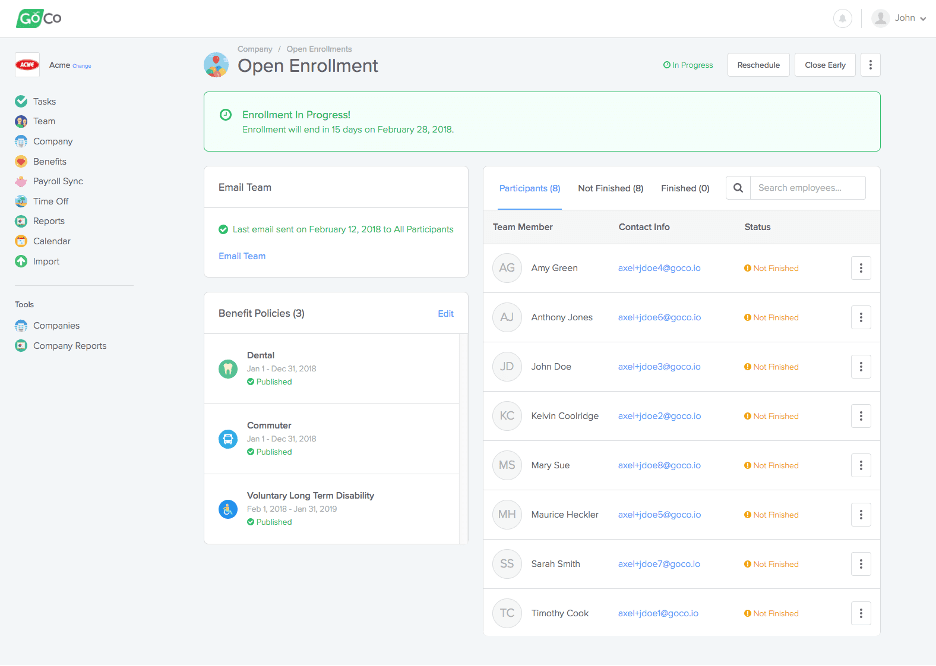
The best HR solutions have features to help you and your staff with benefits enrollment. Source: GoCo
Performance Management
Standard HR software allows you to track and manage employee performance. This can include tools for goal setting and monitoring, succession planning and performance evaluations. Some software also includes personalized dashboards and learning management systems with training courses so you can easily provide mandatory training (e.g., sexual harassment) or professional development training.
Ongoing employee learning and professional development can help with employee recruitment, skill level, expertise and retention.
Legal Compliance
HR software helps you maintain audit-ready records and compliance with labor and employment laws such as the ACA and COBRA. Custom workflows and automation features can help you maintain legal compliance, as they reduce the likelihood of human error by ensuring that certain required measures are being followed every time. HR software companies typically offer customer support via phone, email and chat. The best companies also offer a dedicated support representative who can provide HR guidance along the way.
Reporting
Most HR software provides helpful reporting and analytics. Depending on the type of reports you want, you may need to sign up for a more advanced software plan, but basic plans typically provide data on your team, payroll, taxes and more. HR reporting can be a valuable tool for tracking workforce trends and increasing efficiency across your entire workforce.
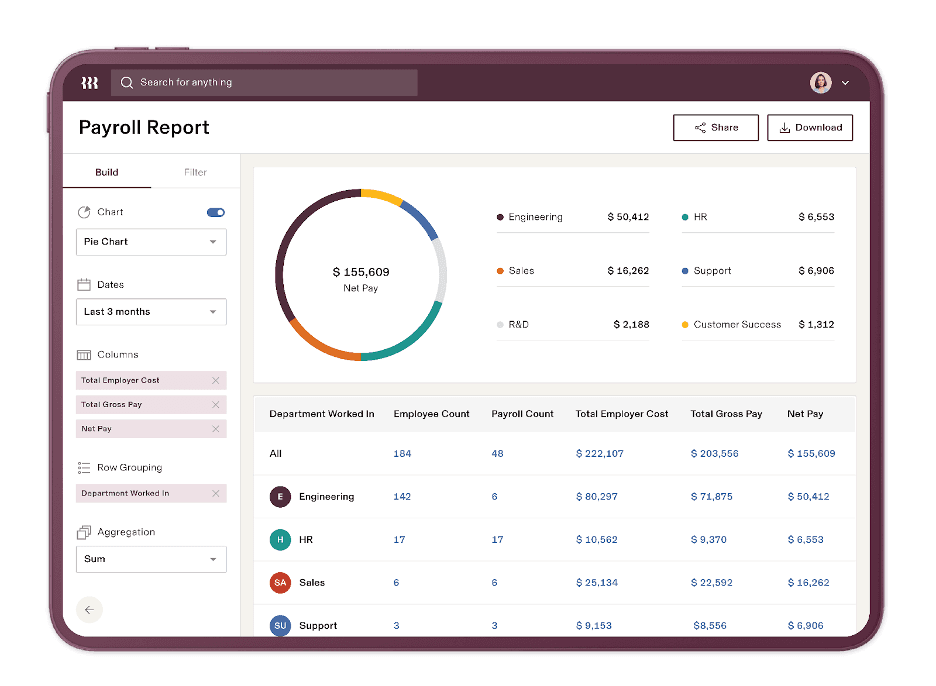
Standard reports such as payroll reports can be a great value-add for employers who want to manage HR costs. Source: Rippling
Self-Service Dashboard
A self-service dashboard allows employees to manage their benefits, request time off and complete performance evaluations. Most systems are cloud-based and offer mobile apps for iOS and Android devices, so employees can access the software wherever they have an internet connection.
There are a few key components to address when you’re choosing the right HR software for your business.
- Identify which features you require. The right HR software package for your company depends on the functions you want to streamline and how the solution will complement other software programs your company is already using. Some businesses need a comprehensive, full-service HR platform to manage all aspects of HR, whereas others may want specialized software to help with one or two aspects.
- Look for important integrations. A key factor to consider is the software’s integration capabilities, primarily if you are already using programs that perform some HR functions. For example, if you need a solution to help onboard and manage employees but want to keep your current payroll system, find employee onboarding HR software that integrates with your current payroll platform. Identify which business platforms you currently use before you choose an HR software program. This will help you select HR software that is compatible with your business’s needs.
- Assess the platform’s functionality and support. The software should be intuitive and easy for your whole team to use. Customer support is also important. HR software handles many important functions of running a business, so make sure help is available when you need it, including at night and on weekends. Common methods of communication include phone, email and web chat. Some vendors and plans also include dedicated support representatives.
- Compare costs and contracts. Cost and contractual obligations are other key aspects to consider. Some HR software can be used on a month-to-month basis, while other vendors require you to sign an annual contract. Think about how much the software will cost you as your organization and HR needs grow.
If you are still looking for the right HR software for your business, check out these additional options. Each one has met our standard for excellence.
Paychex Flex HR Software
Paychex offers all of the features you need to manage your in-office or remote workforce. The software integrates with numerous third-party services, which is ideal for customizing a solution that can serve your workforce. We like how the software allows you to track employees’ information regardless of where they’re located and maintain legal compliance through data analytics, general ledger reports and automatic tax forms. It also offers a secure document management center that serves as a centralized location for remote and hybrid employee documents. It supports multiple uploads, in-app signing capabilities, real-time reporting and rule-based restrictions. Learn more in our detailed Paychex Flex review.
Deel
Deel is a global payroll and compliance platform that helps companies hire and pay employees and contractors worldwide. Its best features include automated payroll processing in over 150 countries, seamless integration with popular accounting software, and comprehensive compliance support to navigate international labor laws. Learn more in our detailed review of Deel.
GoCo
GoCo is an easy-to-use software that starts at $5 per employee per month for premium HR features. You can also customize your plan with additional features like benefits administration, payroll, time management, engagement surveys, performance management, recruiting, HR compliance and advanced workflows. It also offers lifetime access to GoCo’s training specialists to help you and your staff get up to speed with the software. Learn more in our detailed GoCo review.
TriNet HR Software
TriNet has a comprehensive HR software platform that has all of the services and features a startup needs to manage its HR needs. It offers multiple plans and add-ons with monthly and annual contracts. This allows a new business to customize a plan to its needs and budget. The cheapest plan starts at just $8 per employee per month, which is competitive with other HR solutions. TriNet’s modern and intuitive user interface is ideal for companies that want to get started on the platform quickly and easily. Learn more in our detailed review of TriNet’s HR platform.
Papaya Global
Papaya Global is a great choice for international businesses. If you have employees in one or more countries, Papaya Global helps manage your global workforce. It currently offers support for workers in more than 160 countries, which is a wider reach than many competitors provide. If you don’t have a physical entity in the country where you are hiring, Papaya Global can act as your employer of record. We like that Papaya Global can run payroll for all worker types and help you automatically pay workers in their local currencies. Learn more in our detailed Papaya Global review.
As artificial intelligence (AI) continues to make its way into the business world, HR professionals — and the software they use — are forced to adapt. In 2024, HR software will morph into AI-powered technology. Its automation will go beyond scheduling, with bots handling everything from recruitment to performance management. HR software will help create personalized learning journeys for each employee and instantly match candidates with open roles based on skills and company culture.
We anticipate that HR teams will become strategists who use HR software insights to predict engagement dips, prevent burnout, and foster a culture of continuous growth. Your HR pros will be armed with real-time data to proactively address issues before they snowball.
And it’s not just about efficiency; HR software will have features that prioritize well-being in 2024. Gamified interfaces will nudge employees toward healthier habits, while AI will flag potential mental health concerns and connect employees with support resources. We expect to see more “mental fitness” perks, like on-demand mindfulness exercises and AI-powered stress management coaches.
Data privacy will remain important throughout the year. Expect robust encryption, clear user consent processes, and an emphasis on explainable AI. Employees will have more control over their data by deciding what’s shared and for what purpose.