If you have employees, you are probably all too familiar with how challenging it can be to manage your human resources (HR) needs. Although you may have been able to take care of your HR in-house with just a few workers, the burden of HR can become too much as you hire more workers and your business starts to grow. This is when many companies turn to HR outsourcing (HRO) services to manage some (or all) of their HR functions for them.
There are great HRO services on the market, which is why we spent dozens of hours researching and testing them for you. We evaluated and broke down our top options in this guide, reviewing key factors like pricing, features, usability and support.
Human resources outsourcing is exactly what it sounds like: the process of outsourcing your HR functions to a third-party service. While many businesses can handle their HR functions internally through an HR manager or HR department, others turn to experienced third-party vendors like HRO services. HRO services are often flexible, allowing you to outsource only one or all of your HR functions. Some HR functions that are commonly outsourced include recruitment, benefits administration, payroll, time and attendance and legal compliance.
Since the services offered in an HR outsourcing plan can vary widely, so does the cost. The total cost of your HRO will depend largely on how many employees you have, which HR services you need and how long of a contract you are willing to sign. HRO plans run the gamut, costing anywhere from $50 to $1,500 per employee per month.
HR outsourcing services typically follow one of two pricing models:
- A fixed monthly per-employee fee (most common)
- A percentage of each employee’s monthly pretax salary
HROs sometimes have employee or payroll minimums you must meet before you can access their services. Since HR outsourcing is better for midsize and large companies anyway, this is typically not an issue. If you are a very small business seeking HR assistance, a professional employer organization (PEO) service may be a better fit for you.
HRO pricing can be flexible, depending on your provider. Although you’ll likely have to sign a contract, some agencies offer flexibility in the contract’s length. Some HROs offer a la carte options (which are best for those who only need a few select services) or preset bundles (which are best for those who want a more comprehensive set of services). Many HRO companies charge extra for services like employee benefits, recruiting and staffing and performance
HRO plans cost between $50 and $1,500 per employee, per month, depending mainly on the size of your business and the services you need.
Over the years, the role of HR professionals has evolved from simple recordkeeping to becoming an essential component of a business’s executive team. HR departments are responsible for a myriad of activities that all boil down to fostering a positive employee experience. Besides coordinating employee activities, HR professionals provide conflict resolution and training, establish competitive employee benefits and compensation, help manage employment budgets and ensure companies comply with employment laws and regulations. If you don’t have an internal team to handle these responsibilities, you can partner with an HR outsourcing company to meet your needs.
There are several benefits to partnering with an HRO company for both employers and employees, depending on the services your business needs.
1. It saves time and money.
Hiring an HRO service to take care of your HR processes can save your business time and money. Instead of wasting hours performing administrative tasks manually, you can streamline your efforts by outsourcing certain tasks. That means you can reclaim your valuable time to perform revenue-generating functions that will improve your business.
Did You Know?Did you know
Hiring an internal HR staff can cost 50 percent more than outsourcing your HR functions, according to Asure Software.
2. It helps you maintain legal compliance.
Federal, state and local employment laws are changing constantly. As a result, legal compliance has become difficult for many organizations to manage on their own, especially with the recent trend of hiring remote employees located around the state or country. Hiring an HRO to keep you compliant is often easier than trying to stay up to date with a myriad of evolving laws, especially as your company operates in multiple regions.
Your HRO can help maintain the security and privacy of your employee data, including compensation and personal matters. It can also ensure your company’s compliance with federal, state and local regulations surrounding employee benefits ― healthcare, 401(k) retirement plans and time off policies ― harassment and discrimination, workplace safety measures, workers’ compensation, payroll processing and taxation, HR policies, employee discipline and termination and the Consolidated Omnibus Budget Reconciliation Act (COBRA).
3. It streamlines hiring and onboarding employees.
Effective recruitment and onboarding can make a big difference in your business’s success. An HRO can streamline your recruiting, hiring and onboarding processes to ensure you hire the best members for your team. HROs help you not only acquire the right employees but also onboard them in a way that complies with labor and employment laws. For example, your HRO can help you distribute the necessary new-hire documents, obtain the required signatures and file the documents securely.
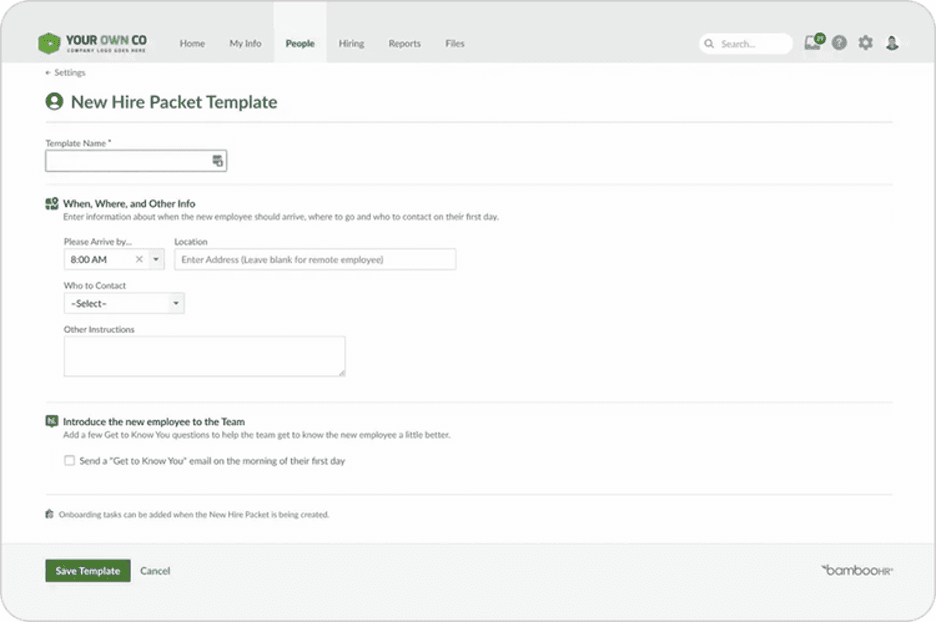
Some HR solutions offer templates for things like new hire packets, to help you quickly create effective onboarding materials. Source: BambooHR
If your company hires immigrants, you can benefit from an HR outsourcing service that is well-versed in international employment laws and has experience with the foreign worker hiring process. Immigration compliance at both the state and federal levels is a complicated process that your own HR staff may not have expertise in. HROs help protect your company and immigrant workers from unintended and potentially costly violations of immigration law.
4. It provides expert HR insight and support.
Managing every HR task for your team is a big feat, even in a small business. Without an entire department to manage and track your HR needs, there is a good chance you will need to hire a service like an HRO to help you. Even if you have an internal HR manager, they can benefit from a helping hand and additional expertise. An HRO can help you meet all your company’s HR needs, even if you’re on a tight budget.
5. It is a scalable HR solution.
Although some HROs offer bundled plans, others allow you to create unique service plans with a la carte HR features. This flexibility is convenient for any business but especially for growing organizations that need their HR support to expand as they scale up. Instead of being limited by your HR capabilities, you can add and remove HR services as soon as they apply (or don’t apply) to your organization.
Just about any HR function can be outsourced. You can outsource a couple of HR functions at a time or all your HR needs together.
Here are some commonly outsourced HR functions:
- Applicant tracking
- Background check services
- COBRA insurance
- Compensation plan development
- Employee benefits administration
- Employee discipline
- Employee handbook creation
- Employee recruitment
- Employee termination assistance
- Employee training and development
- HR administrative tasks
- HR audits and consulting
- HR policy development and implementation
- New-hire reporting
- Payroll
- Retirement services
- Risk management and regulatory compliance
- Tax administration and compliance
- Time and attendance
- Unemployment insurance and claims administration
- Workers’ compensation
- Workplace safety training
Although these are the most commonly outsourced HR services, this is not a complete list of HR functions that can be outsourced. Speak with an HRO representative if you have questions about outsourcing additional HR functions.
When selecting an HR outsourcing provider, assess the HR services you need assistance with ― maybe you need to outsource all of them or only a few. Many HROs allow you to choose either a full-service package or the specific services your business needs.
Regardless of how many HR services you need to outsource, the HRO you choose should have expertise in your industry and state’s employment compliance to insulate your company from penalties or lawsuits.
Full-Service HR Outsourcing
A full-service HRO is a good option if you own a small company and cannot yet afford to hire HR personnel. It provides the resources that an in-house HR staff could without the expense of hiring your own team. A full-service HRO is also advantageous if you have workers in different parts of the U.S. or the world. HROs are knowledgeable about global, federal and state employment laws, so they will ensure your company complies with the local regulations anywhere you have employees.
When companies skimp on HR, they put the business and their employees at risk. A full-service HRO helps you appropriately manage day-to-day HR tasks like reporting misconduct and ensuring workplace safety compliance. These services also work closely with your payroll team to handle compensation. In addition to day-to-day tasks, you can enroll in services like recruiting and employee training.
Partial HR Outsourcing
Partial outsourcing is recommended for companies that have an in-house HR staff but need extra help. For example, perhaps you have an HR representative who handles your recruiting strategy and ensures the correct filing of your employment paperwork, but you need help with employee development. If you do not have the resources or desire to hire a full-time training specialist, you can outsource this service to an HR company, many of which offer employee training and development programs.
The most common skill development training that HROs provide is software and processes training, although other options are available. The best HR outsourcing services will work with you one on one to determine the best training programs for your employees.
Other common partial outsourcing services are payroll processing, employee screenings and background checks, employee recruitment and immigration compliance.
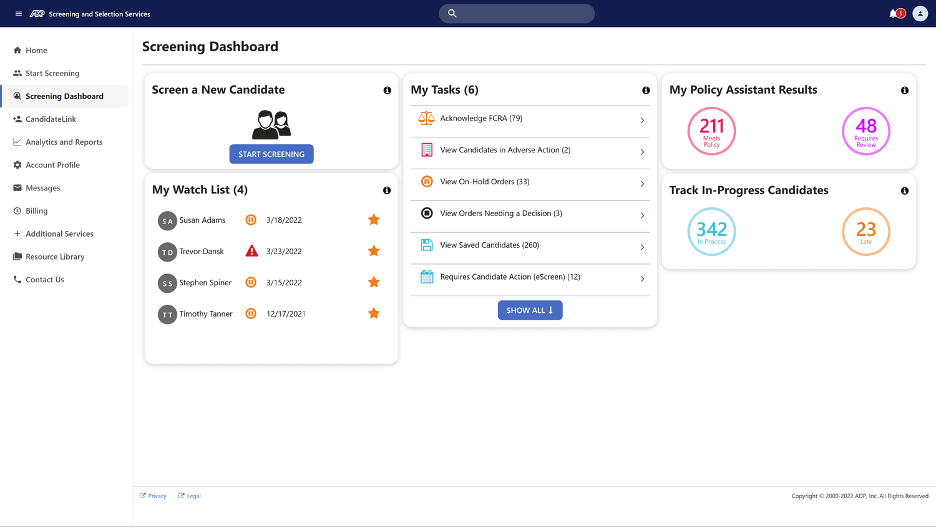
HROs can help you manage many HR functions, like employee screenings. Source: ADP
During your research on HR outsourcing, you may also see references to professional employer organizations or PEOs. While many of the companies we reviewed offer both HR outsourcing and PEO services, they are not the same thing.
The main difference between an HRO and a PEO service is the legal employment arrangement they operate under. When you outsource your HR functions, you are still the employer of record for your staff members and you retain full control of your business operations and data. With a PEO, the company you hire acts as a co-employer and is responsible for all your business’s HR tasks, including hiring and firing, employee training and tax and compliance obligations.
Which Option Is Best for My Business?
Whether you should use an HRO or a PEO depends on your business’s needs. If you need help with a few basic administrative tasks, like payroll and benefits management, an HRO might be your best option. If you’d rather have an expert company shoulder the full legal and financial responsibilities of employing your staff members, hire a PEO.
If you are interested in learning more about PEOs and the companies we recommend, check out our selection of the best PEO service providers.
If you need to partner with a PEO right now but think you’ll want to switch to HR outsourcing later or vice versa, consider a company that offers both.
If you’re still looking for the right HRO for your business, here are a few more top-rated contenders worth exploring. These vendors all passed our rigorous testing and evaluation process as well.
BambooHR
BambooHR offers a variety of useful HR functions to help you hire, manage and pay your workers. You can choose BambooHR’s Core or Pro plan and customize it with add-ons like payroll processing, time tracking and benefits administration. Every plan comes with crucial employee management tools like employee record management, time off management, employee self-service and reporting and analytics. The Pro plan takes it a step further with features for managing employee performance and experience. Learn more in our detailed BambooHR review.
Gusto
Gusto is a full-service HR platform that offers comprehensive HR tools and services like hiring and onboarding, employee benefits administration, HR insights and reporting, talent management and HR guidance and support. However, one standout feature is its payroll functionality. Employers can access full-service payroll for multiple states, multiple pay rates and schedules and international contractor payments. Gusto can register you for state payroll taxes, as well as file and pay federal, state and local payroll taxes automatically on your behalf. You can set up Gusto to run your payroll automatically each pay period. If you want to pay international employees, Gusto now offers employer-of-record (EOR) capabilities for global employee onboarding and payroll. Learn more in our detailed Gusto review.
WorkSight by G&A Partners
WorkSight is HR technology from G&A Partners ― together, the two offerings bring employers a reliable system that is great for training and upskilling workers. G&A helps develop your employees from the very beginning by offering recruitment process outsourcing services. With these services, the HRO can help find and vet the best candidates for your business. It is especially ideal for particular recruiting projects. Once employees are hired, the HR solution can help onboard and train your new hires. Learn more in our detailed WorkSight review.
As workplace trends continue to change throughout 2024, we expect the demand for human resources outsourcing to keep growing. There are several factors that play into this, such as the hybrid work environment, global expansion, younger generations taking over the workforce, the increase in AI and automation, employee health and development and the increasingly complicated need to comply with state and federal regulations. In-house HR staff may have difficulty staying up to date with changing trends and regulations and HR missteps can have expensive consequences for small businesses. As a result, many organizations rely on HROs to monitor shifting employment laws and workplace trends closely.
The popularity of the hybrid workplace is a trend that significantly affected the HRO industry and will continue to do so throughout 2024. With many businesses permanently settling on hybrid work arrangements – and expanding their workforces globally – the need for cloud-based payroll and time-tracking tools has risen. Employees and employers need the ability to access their HR information from any location. We expect HRO companies to increase their offerings of flexible, cloud-based solutions and self-service features.
In our increasing global economy, many companies are choosing to hire workers across multiple states and countries. We can expect HR outsourcing companies to keep up with this trend by offering more global compliance and payroll support for international employees and contractors. With this expansion, we also anticipate HROs to tighten up their cybersecurity measures to ensure employee data remains secure.
As younger generations take over the workforce, HROs must evolve to meet their needs. For example, younger generations place a high importance on collaboration and recognition. HROs must manage HR to make employees feel seen and appreciated. Additionally, younger generations place great importance on health, wellness and professional development. We anticipate HROs will tailor their benefits packages to satisfy these needs as well.
Artificial intelligence (AI) in HR technology is also influencing the growth of HROs. For example, AI can scan hundreds of resumes to find candidates who have the required experience for a role, saving hiring managers hours of sifting through resumes. In tandem, laws around using AI for hiring and recruitment are evolving as well, and we anticipate that HROs will be able to stay up to date on compliance measures.
We expect to see HROs helping with important business diversity and inclusion initiatives throughout 2024 by offering recruiting assistance, risk management and compliance measures and employee training and development. Small businesses can lean on outsourced services like applicant tracking, HR policy development, audits and consultation to create diverse and inclusive workplaces. We believe there will be an increased demand for data analytics to track and improve employee productivity.