Businesses that employ a fleet of vehicles need to keep tabs on them to ensure routes are completed in a timely manner, drivers are engaging in safe behaviors, preventive maintenance is performed as needed and that their expensive vehicles are all accounted for. Advancements in GPS technology has made this easier than ever with sophisticated GPS fleet management systems designed to help businesses stay on top of their entire fleet’s whereabouts at all times. Complete with real-time alerts and notifications, fleet managers can rest assured they’re up to date on all of the above and there will be no unpleasant surprises.
The best GPS fleet management services offer easy-to-use software, hardware that’s simple to install, and valuable tracking, driver safety and fuel performance features. To help you find the best GPS fleet tracking systems for your business, we researched the top names on the market. We scrutinized each to determine their ease of use, price and safety features before arriving at our best picks for small businesses in 2024.
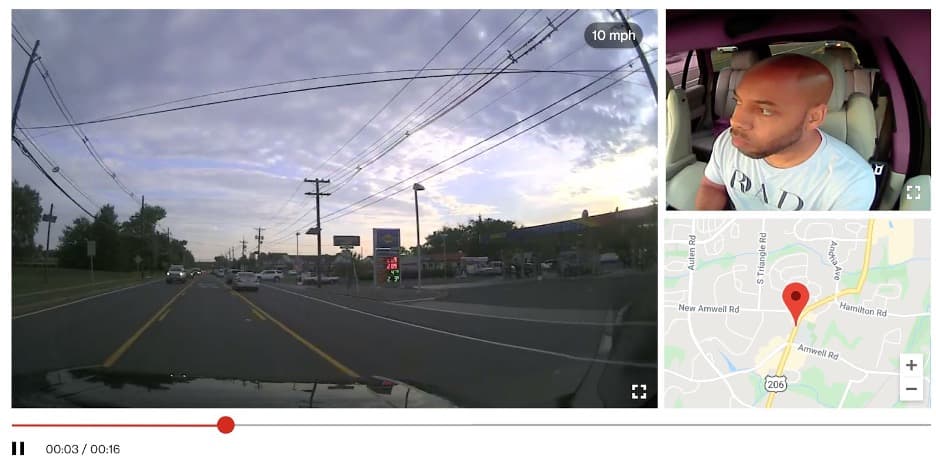
Many GPS platform dash cams automatically record the road and the driver when they detect an incident, sending it back to a fleet manager for review. (Source: Verizon Connect)
There are many excellent vendors offering GPS fleet management solutions. Six more you may wish to consider are:
Motive (formerly known as KeepTruckin)
Driver and road safety are central to Motive. We were impressed by how the platform’s smart dash cams film both the road and the driver in-cab and start recording automatically when they detect high-risk behaviors. Unique to Motive, they employ hundreds of staff who review and make notes on incident footage prior to upload to fleet managers’ dashboards. The software also scores driver safety and behavior, taking into account weather and traffic conditions to deliver fair assessments. There’s a lot more to Motive than driver safety, though. The platform offers a range of detailed reports on compliance, fuel use and vehicle maintenance. Fleet managers can also manage fuel cards via the platform, establish individual vehicle maintenance schedules and more efficiently route drivers taking into account factors like vehicle and driver HoS stipulations. For a full breakdown, check out our detailed Motive GPS Fleet Management review.
ClearpathGPS
ClearpathGPS is ideal for companies on a tight budget. For $20 per month per vehicle, your subscription includes driver reports, ELD support, geofencing, and traffic overlays. For $5 extra, you get real-time alerts, advanced reports, open API access, and more integrations. AI dash cams cost $30 per month per vehicle. ClearpathGPS offers flexible terms with just 30 days’ notice and a 30-day free trial.
The platform is easy to use and feature-packed. There are two maintenance options to keep your vehicles on the road and managers can set a wide range of alerts to be notified on issues like speeding and out-of-hours usage. We like how ClearpathGPS gives you the choice between plug-and-play and hardwired GPS trackers – many providers now only offer plug and play. Click to find out more with our comprehensive ClearpathGPS review.
Force
Force has long been a leading provider of GPS fleet management for smaller businesses. While that’s still where their focus lies, we like how the company has adapted the system to appeal to a wider base as they have removed the previous limit of 30 vehicles per fleet and they can now track Class 6, 7 and 8 vehicles.
Force’s smart mix of features and functionality also makes it a great choice for expanding local businesses thanks to its competitive pricing, easy scalability and excellent customer service. We were particularly impressed by the integration with Housecall Pro, which companies can use to create, schedule, and move jobs, and text customers to let them know that a company representative is on their way to their location. The proactive maintenance tools excel, alerting managers to potential and emerging vehicle issues, so you can keep them on the road for longer. For more information, read our in-depth review of Force.
GPS Trackit
For companies needing robust video telematics and a fully-featured GPS fleet management service, we recommend that you include GPS TrackIt on your shortlist of prospective vendors. GPS TrackIt’s VidFleet One and VidFleet AI+ dash cams are best in class, offering 360-degree views, tamper detection and eye-tracking. We love how the platform’s multi channel splitter can record from up to four HD cameras simultaneously so you get the fullest possible view of driver behavior when the system records an event. The platform shines in its reporting and analytics capabilities, allowing managers to track a range of vehicle and driver metrics from speed and onboard temperature to safety and fuel performance. Find out more by reading our GPS Trackit review.
FleetUp
FleetUp boasts a highly satisfied user base thanks to its laser focus on keeping customers happy. Key to this is their comprehensive, around-the-clock support the company offers by phone, email and online chat. After you sign up, you’re assigned a company rep to help you with system set up. It’s excellent that all this help is available but you may not need to use it as FleetUp has one of the most intuitive and user-friendly dashboards on the market. Fleet managers will find vehicle maintenance and management easy setting up alerts on a range of metrics from low battery voltage and engine temperature to idling and sharp turning. We were impressed at how well implemented the driver and admin/manager mobile apps were in handling everything from managing maintenance schedules to sharing DVIRS with mechanics. For a run-down of its main features, visit our review of FleetUp.
RAM Tracking
RAM Tracking stands out as the best GPS fleet management platform for fleets with three to 10 vehicles. This budget-friendly service starts at $10 per month per vehicle for GPS tracking with the option to choose extras live multi-camera tracking and AI-powered dash cams for a minimal extra charge. Users benefit from 30 different types of reports, 60 hours of cloud recording and isolated recording of incidents on the road that can be recalled if needed as evidence. There is a free 30-day trial if you want to try the system out before committing.
There is no one-size-fits-all solution to fleet management tracking. Providers know this and they aim to provide solutions tailored to your business’s specific needs. While many providers require a 36-month contract, others offer 30-day rolling contracts.
The price depends on the number of vehicles or assets you track and the vehicle, driver and asset data you want. Some providers include all data and features with their per-vehicle, per-month price while others offer a base set of functions that you can supplement with additional subscriptions and third-party contracts.
If you are new to fleet management tracking, you might benefit from choosing a provider offering a free or paid-for trial or a 30-day, money-back guarantee. That way, you can test whether you need the service without committing your company to a long contract.
When choosing a GPS tracking service, you should ensure that the hardware and software can provide you with access to the data you need to improve and streamline operations.
Hardware and Installation
All GPS fleet tracking services we reviewed offer plug-and-play hardware, including the trackers themselves. They plug into the OBD-II port on your vehicle. With most providers, it takes around 10 minutes to install a device and connect it to the software. You can move GPS trackers between vehicles at any time.
Some providers offer hardwired trackers. They require professional installation, often at an additional cost. They are less prone to tampering and do not require as much maintenance.
Most providers offer dashcams (many of them powered by AI), asset trackers, trailer trackers, heavy equipment trackers and driver ID readers.
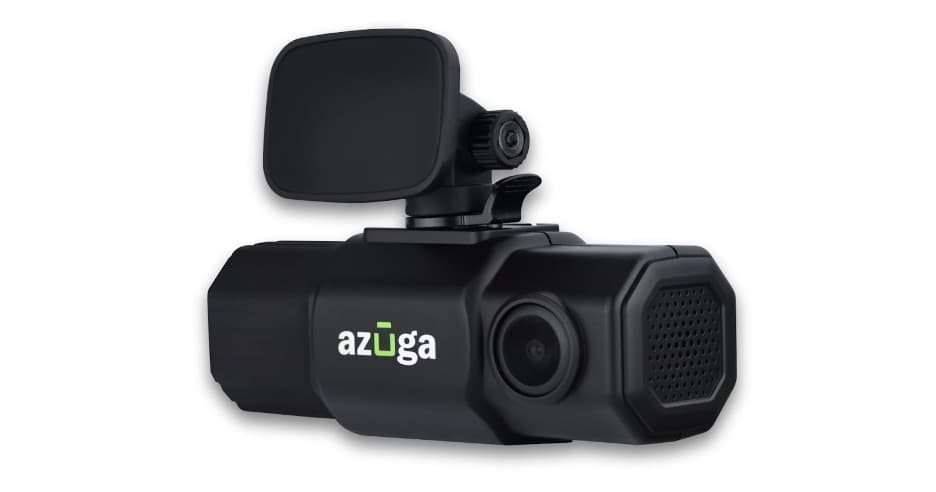
This Azuga dash cam is AI-powered and films the road and the driver in-cab. Source: Azuga
Driver Safety and Performance
GPS fleet tracking systems allow companies to monitor the performance of their drivers for safety and fuel efficiency.
Incidents of unsafe driving that wastes fuel are recorded and sent to the control dashboard, including events like harsh driving, speeding, hard braking, rapid acceleration, aggressive cornering, idling, fuel usage, cell phone distractions, unauthorized usage and engine on/off times.
Some systems create driver quality scores from this information, allowing you to see which drivers are behaving responsibly and which may need additional training.
Vehicle Condition and Maintenance
Maintaining the health of your fleet is imperative to reduce costs and increase safety and performance. Fleet management software can record the fuel level, battery voltage, odometer reading and coolant and engine temperatures of each company vehicle. The sensors within your vehicle hardware also alert you to DTCs that indicate emerging problems, sending fault data to your control dashboard.
Many fleet tracking platforms allow you to set a timetable for preventive maintenance.
Alerts and Reports
Many systems send automatic alerts to drivers, system admins and supervisors, as well as people at destinations where your vehicles are headed. Choose what you want them to be notified of and the system will take care of it.
For example, in addition to DTC alerts, you can tell the system to notify you and your driver of unsafe driving habits in real time.
Your system collects and stores a lot of data on vehicles, drivers and trips. You can run reports on that data to identify driver training needs and fuel consumption trends, such as fuel wasted through unsafe or poor driving habits.
These reports provide the insight you need to save money and increase efficiency across your business.
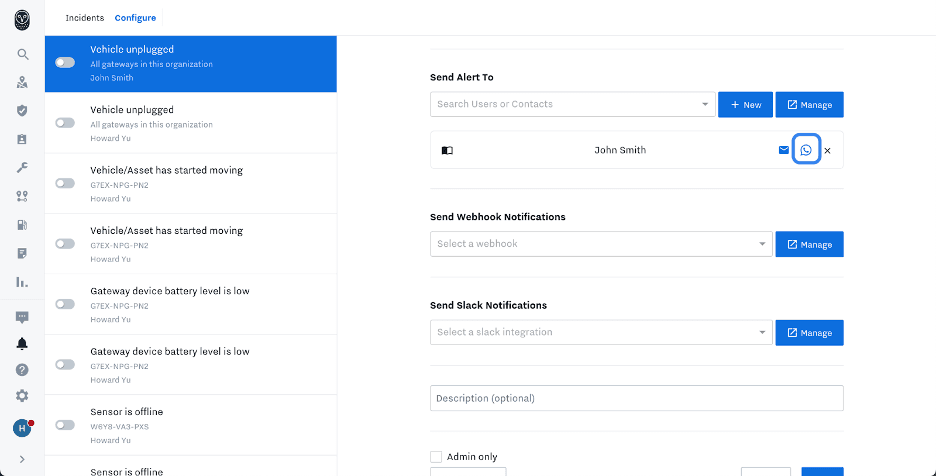
Many GPS platforms allow you to set alerts to be notified immediately on factors ranging from driver behavior to vehicle engine performance. Source: Samara
Location and Navigation
All GPS fleet tracking systems send back each vehicle’s position at intervals between one second and five minutes. You’ll be able to see each vehicle in real time on your control dashboard map, many of which allow you to click in to see which driver is behind the wheel, when they started their trip, their final destination, their estimated time of arrival and other notes.
Most systems offer in-cab driving directions to drivers, often via a mobile app. This allows drivers to take the quickest and most efficient route. This type of GPS navigation is different from car navigation services offered by Google and Apple. Professional GPS navigation will direct drivers to roads that are legal to drive on depending on the type and size of vehicle they’re driving.
If real-time reporting is important to you, make sure the vendor you select truly offers it. Only a few of the companies we reviewed offer reporting from one second to the next.
Usability
Fleet management systems are controlled via the online dashboard. All providers have attempted to create an intuitive UI, although some providers do this better than others. For brand-new fleet tracking system users, you may want to choose a provider with an extensive online knowledge base that offers tips and techniques about how to get the most from your system.
Some mobile apps offer system supervisors and administrators the full range of features available on the PC/Mac desktop dashboard; however, some providers offer limited mobile functionality.
Many providers offer REST API interfaces, allowing data on the platform to be integrated into third-party programs like Salesforce and other top CRM software solutions.
Customer Service
Customer service levels vary from provider to provider. Some offer 24/7 access while others are available during working hours only. Some make it easy to speak with representatives on the phone while others prefer you to communicate by email, help desk or ticketing system. A few companies provide named accounts or customer success representatives to customers.
With fleet tracking services, you can track and improve your drivers’ performance and safety, schedule vehicle maintenance, track your vehicles’ and assets’ locations, monitor and improve fuel efficiency and optimize navigation. Monitoring your vehicles, assets and drivers can help you maintain a safe workplace and cut costs.
GPS tracking is especially important for businesses with high-value mobile assets like trailers, tractors, storage containers, construction equipment and generators.
GPS tracking systems use hardware to collect the data from vehicles and other assets and software to present and analyze the data. On vehicles, the equipment can be hardwired or plugged straight into the OBD-II port. On assets, monitoring equipment is normally attached to the outside of the asset and powered by batteries that can provide power for up to 12 months.
Most GPS fleet tracking providers don’t require you to download apps or programs to your PC or Mac to access data. You can access their platforms via internet browsers like Chrome, Firefox and Edge. You will need to download mobile phone apps.
On GPS fleet tracking dashboards, you can see live information on your vehicles, their location and the trip they’re making. You can run reports on driver safety and performance, fuel efficiency and optimization, geofences and route navigation and vehicle condition and maintenance to improve efficiency.
GPS fleet tracking offers a lot of benefits, such as improving driver safety and ensuring your vehicles are getting the right maintenance. This can help you lower costs and boost profits.
When getting quotes for a fleet management services, ask the following questions:
- Do you offer a free trial or demo? Some companies offer a 30-day trial of their hardware and software. This is crucial if the company you’re considering requires you to sign a long-term contract. Even if you’ve already made up your mind, take advantage of the free trial period.
- What is the refresh time? Many of the software vendors say they offer real-time tracking, but it is usually not technically in real time. GPS fleet tracking software may refresh anywhere from every second to every five minutes, depending on the company. Of the companies we reviewed, only a few offer real-time, second-to-second tracking. The rest have a refresh rate ranging from 10 seconds to three minutes.
- What type of hardware and software do you include in the cost? Fleet tracking hardware usually are plug-and-play devices that are about the size of a deck of cards and can be inserted into your vehicle’s OBD-II port. More advanced hardware includes separate pieces that link with information centers in your vehicles. The software is usually cloud-based and usable on desktops, tablets and smartphones.
- Is all functionality included? All services come with a wide set of features. However, some providers have tiered service plans that charge extra for some features. When speaking with a company, get a quote for the exact features you want.
The fleet management market is expected to increase in value from $23.67 billion in 2023 to $79.82 billion in 2030, according to Fortune Business Insights.
The decline in profitability is likely to lead many companies to concentrate on cost control as a way of preserving margins. We believe that GPS fleet management systems will play an important role in this and that, in line with the prediction that the market will triple in size before 2030, many more companies will adopt this technology.
Many fleet managers now believe that dashcams are an important part of their work, particularly for providing evidence that will exonerate their drivers of blame in accidents. Force, one of the United States’ most popular GPS fleet tracking solutions providers, has occupied a healthy market share for many years without a dashcam offering. They’re working on one now that’s close to launch demonstrating how the appeal of cameras has trickled down from multinationals driving on interstates to local businesses serving a community.
In our prediction for 2023, we forecast that 5G’s greater bandwidth and lower latency would become more widespread. That’s proven to be the case although many of the providers we’ve reviewed cap their services at LTE or 4G speed. We expect more of them to offer 5G connectivity in 2024. There are multiple use cases here ― for example, software could ping a customer by text to let them know their delivery or service provider is close by. Instead of providing a link to watch them on a map, they could see the last mile drive to their home on their mobile devices.
While there has been a tremendous drive toward pushing for electric fleets. However, we don’t see that accelerating as fast as some predict because of range anxiety and high breakdown costs related to EVs. The switch is coming but not as quickly as some may believe or hope.