In today’s digital age, customers expect a seamless buying experience, and that includes offering a variety of payment options. But if you’re not set up for credit card processing, you’re missing out on a huge chunk of potential sales.
The good news? Accepting credit cards is easier than you think. This article will walk you through the entire credit card processing process, from choosing the right provider to understanding the fees involved. We already did the heavy lifting by reviewing dozens of processors and narrowing them down to our best picks. By the end of this guide, you’ll be equipped to unlock the power of credit card payments and watch your sales soar.
Helcim
Helcim goes beyond most credit card processors in the tools that it offers to support your business. Its software has advanced capabilities, such as POS services, customer management, inventory management and employee tracking and management ― functions that some other processors only include in their more expensive plans. This versatile platform earns Helcim our pick for the best all-in-one credit card processor.
Sekure
Sekure is a credit card processing broker that gives businesses the options they need when choosing a payment processing provider. With Sekure, you can choose from multiple payment methods and craft a plan that suits your budget and transaction volume. We liked how Sekure can help you navigate the credit card processing space to find a reliable provider that offers the personalized service your business needs.
Chase Payment Solutions
Chase is one of the largest banks in the United States and a major credit card issuer, which gives it unparalleled insight into consumer spending. Businesses that sign up for credit card processing with Chase Payment Solutions can access the bank’s vast trove of data. Leveraging big data effectively allows small businesses to target potential customers. This feature differentiates Chase Payment Solutions from other processors, which is why we chose it as our best pick for data analytics.
Stripe
We think that online business owners will appreciate Stripe for its e-commerce tools! In our testing of the service, we found that setting up online payments is a breeze with their user-friendly platform. Plus, it seamlessly connects with platforms like Shopify and Magento, keeping checkout smooth for customers. But we like that Stripe offers more than just ease of use. You can customize our store exactly how we want, and their robust security features keep transactions safe.
National Processing
We chose National Processing as the best credit card processor for low transaction rates because its interchange-plus rates are low compared to other processors. It also boasts a rate-lock guarantee, which means your rates won’t increase during your contract. National Processing is also willing to match or beat competitors’ rates, which we found to be a unique benefit among the processors that we examined. National Processing will pay you $500 if it can’t beat your current rate.
Flagship Merchant Services
Flagship Merchant Services is a full-service payment processing company that allows merchants to take payments online, in person, by mail and over the phone. While many processors lock merchants into multi year agreements with cancellation fees, Flagship offers merchant account services to all of its customers on a month-to-month basis and doesn’t charge a cancellation fee. That’s why Flagship is our best pick for flexible contracts.
Finix
In our view, Finix is a game-changer for high-growth business. Unlike other processors with one-size-fits-all solutions, Finix lets you customize the entire payment experience. We like that you can build a system that perfectly fits your unique needs, and it can grow and adapt right alongside your business. Plus, their robust API allows for seamless integrations with existing tools. Whether we’re adding new features or expanding to new markets, we were impressed that Finix is built to handle it all.
Finix’s APIs allow users to quickly and easily build custom integrations. Source: Finix
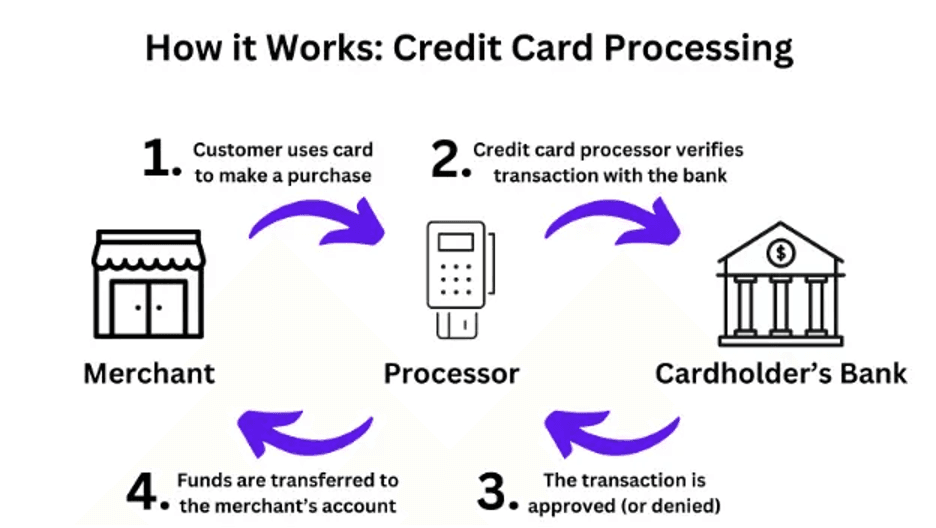
Credit card processing is the process of transferring money from a cardholder’s account to a merchant’s account when the cardholder pays for a purchase with a credit or debit card. Though the process is simple and takes just a few seconds on the front end, the back end of the process is intricate, with data traveling between the merchant, processor, credit card network and multiple banks.
Credit card processing rates are typically expressed as a percentage of the sale plus a small per-transaction fee. Most rates average 2% to 4% of each transaction. The processor considers several factors to determine the processing fees it charges you, including your monthly processing volume, your average ticket size, your business’ industry and your processing history. It may also consider your business and personal credit.
The credit card processing industry is very competitive. Companies want to work with you, especially if you’ve been in business for a few years and process a high volume of payments each month. Many are open to negotiating a deal with you and advertise that they’re willing to meet or beat your current rates. But first, you need to understand what costs go into credit card processing rates and which are negotiable. All rates have three parts:
- Interchange fees: This is a nonnegotiable rate set by the card networks and every processor pays the same amount. There are hundreds of rates, arranged by industry, card type, sales ticket amount and acceptance method. You can view interchange rate tables on the card networks’ websites.
- Assessment fees: Like interchange rates, these are nonnegotiable and every processor pays the same amount. These rates vary by card brand.
- Processor’s markup: This is the only negotiable part of the processing rate.
Here’s why you need to know this information:
- If a company says it has lower interchange rates than other processors, it’s not true. All processors pay the same amount.
- If a company posts links to interchange rate tables, indicating that this is what you’ll pay, you need to know that this is only a portion of the rates you’ll pay the processor.
Second, you need to identify which pricing model is best for your business. For most businesses, industry experts recommend interchange-plus pricing, but credit card processing companies prefer tiered pricing because they make more money with it. Some processors give you a choice of pricing models and may allow you to switch so that you can evaluate for yourself which one provides the best savings for your business. Here are the three most common:
Credit Card Processing Pricing Models
Tiered pricing | Interchange-plus pricing | Flat-rate pricing |
|---|---|---|
Most plans include the following tiers, with different rates for debit and credit cards at each tier:
| Interchange-plus pricing has two parts:
| Flat-rate pricing is expressed as one of the following:
|
It’s hard to know how much you’re paying the processor – or if you’re overpaying – because each processor decides which rates go into each tier. | You can see the processor’s markup, which makes it easier to determine if you’re getting a good deal. This is usually the most cost-effective pricing model. | Flat rates are higher than the prices in the other models but may save you money, because most have no additional fees and no contract. |
This pricing model is a good choice if your customers prefer paying with debit cards. | This is the pricing model most experts recommend for small businesses. | This is the best pricing model for businesses with small tickets or low monthly volume. |
Tiered Pricing
This is the most common pricing model, but it’s widely criticized by industry experts because it’s not as transparent as interchange-plus pricing. It attempts to simplify the interchange table by combining interchange rates, assessment fees and markups and then sorting them into tiers. Tiered pricing is also referred to as “bundled pricing” or “bucket pricing.”
Most processors categorize these tiers as qualified, midqualified and nonqualified transactions, although some plans may have only two or up to six tiers, with separate rates for credit and debit cards. The factors that determine the transaction category include the type of card ― whether it’s debit or credit and if it’s a regular, rewards, corporate, government-issued or international card ― and how the transaction is processed, whether you accept the card in person using a card reader, accept it online or key it in manually.
Did You Know?Did you know
Some processors have a special lower rate for PIN debit transactions.
Critics note a variance between processors as to which interchange rates fall into each tier, which makes it difficult to compare pricing between services. We found this to be true in our research as some processors categorize rewards cards as midqualified and others define them as nonqualified. This variance in tier categorization, sometimes referred to as “inconsistent buckets,” makes it difficult to determine how much you can expect to pay above the set costs for your processing:
- Low rates advertised on processor websites are usually qualified debit rates. These only apply to nonrewards debit cards accepted in person with a card reader.
- Qualified debit and qualified credit may be the only rates the sales rep quotes you, so it’s important to ask about the number of tiers, what they cost, which types of cards and acceptance methods each tier includes and what actions may cause a transaction to be downgraded to a lower tier.
- The tiered pricing model is best for businesses whose customers prefer paying by debit card.
Interchange-Plus Pricing
Most industry experts prefer this model because it promotes pricing transparency. The interchange-plus pricing model may also be called “pass-through pricing” or “cost-plus pricing,” because the processor passes the interchange rates and assessment fees to you at cost and adds a markup.
The processor’s markup stays the same no matter what card type your customers pay with, so you can see how much you’re paying the processor. This makes it easier to spot savings when you’re comparing services. Also, many of the companies that offer interchange-plus pricing post their rates on their websites, which saves you time in gathering rates from the companies you’re interested in learning more about:
- Many companies will quote you interchange-plus rates if you specifically request it, but some only offer this type of pricing to established customers, requiring you to process with them for a certain amount of time before you qualify. The best companies offer this pricing to all their customers.
- The rate you’re quoted is only the markup. You’ll pay this amount in addition to the actual interchange rate and assessment fee.
- Interchange-plus pricing is best for most businesses, and it’s the pricing model recommended by industry experts.
Flat-Rate Pricing
This is the simplest pricing model. Most processors that use this model charge a fixed percentage rate for each sale, regardless of card type. Alternatively, some processors charge a fixed percentage rate and a per-transaction fee. There are usually different rates for cards accepted in person and online.
Mobile credit card processing companies commonly use this pricing model. There are typically no monthly or annual fees, making it a good option for small businesses that don’t process enough transactions to cover these costs. Most of the time, the only other fee is a chargeback fee, which is only triggered when a customer disputes a transaction.
- If your business processes less than $2,500 per month, some credit card processors will refer you to a processor with flat-rate pricing.
- Most companies that offer this pricing structure set you up as a submerchant under their master merchant accounts, allowing for fast setup.
- Flat-rate pricing is best for businesses that have small sales tickets or process a low volume of credit card transactions each month.
In addition to processing rates, you’ll pay various fees to whichever credit card processor you choose. Some of these are one-time or per-occurrence fees and others are charged monthly or annually.
For a complete list and explanation of fees, including nonstandard fees that you should never pay, see our small business guide to credit card processing fees.
Common Credit Card Processing Fees
Most credit card processing companies charge these recurring fees:
- The monthly fee (sometimes called a statement fee) usually ranges from $5 to $15. It may be higher if it includes PCI compliance and gateway fees.
- The monthly minimum fee is normally $25, although this usually means the amount you pay in processing costs, not the minimum dollar amount of sales you must process per month.
- PCI compliance is $100 per year on average, although some companies may prorate it and charge it monthly, sometimes including it into the monthly fee.
- The payment gateway fee varies by the payment gateway you use. Most are charged monthly, although some companies also charge a small per-transaction fee.
- Various network fees , such as Mastercard’s Merchant Location Fee and Visa’s Fixed Acquirer Network Fee, may be passed on to you as either monthly or annual fees.
These fees are also common but only charged per occurrence:
- Batch fees are nominal daily fees that you pay when you close out the day’s sales, costing 10 to 30 cents and usually the same amount as your per-transaction fee.
- Address verification service (AVS) fees are usually a few cents per transaction when you use this anti-fraud tool to verify the address and ZIP code of the cardholder.
- Voice authorization is another antifraud tool with a small per-use fee. It’s rarely required, but you’re charged for each occurrence.
- Chargeback fees are usually $15 or $20 per incident but may be as much as $45.
- PCI noncompliance is a high monthly fee that you must pay if you fail to establish and maintain your PCI compliance. [Learn about other payment processing laws and regulations .]
- A nonsufficient funds (NSF) fee is charged if you don’t have enough money in your business bank account to pay the fees you owe the processor.
Fees to Avoid
Some processors charge a variety of miscellaneous fees in addition to the standard fees listed above. Some of the worst are cancellation fees, club or membership fees and fees for what the contract vaguely defines as “additional services.”
Hidden Fees
Again, it’s important to read the entire contract before you sign anything to make sure no fees are tucked away in the fine print. As you read the contract, note every fee it lists. Then, before you sign the contract, ask your sales rep what each fee is for, how much it costs, how frequently it’s charged and if it can be waived. If the sales rep agrees to waive a fee, be sure to get this in writing, either in the contract or as an addendum.
No matter which credit card processing service you select, you should expect it to provide the basic services that you need to accept payments. The processor should:
- Allow you to accept all major cards, including Discover and American Express, so you don’t lose sales from users of certain cards.
- Comply fully with the PCI Data Security Standard (PCI DSS) and help you attain PCI compliance.
- Offer EMV-compliant card readers to reduce your vulnerability to fraud and to ensure that, in the event of a security breach, you aren’t held liable for using outdated equipment.
- Provide readily accessible customer support that you can reach by phone 24/7 so that, no matter what hours your business keeps, you can get the assistance you need immediately.
Square offers an easy-to-use EMV card reader. Source: Square
In addition to these criteria, we considered the following factors to evaluate each processing company.
- Pricing: We looked at processing rates and account fees to find out how much it costs to accept credit card payments with each company. We also considered the pricing model the company uses and how transparent it is about its pricing.
- Contracts and service terms: Standard processing contracts have lengthy terms and hefty early termination fees that make it difficult to switch providers. We looked for processors that offer month-to-month service with no cancellation fees, rather than locking you into a service.
- Selection of processing types: Many small businesses want to accept payments wherever their customers are, so we considered whether the processor offers multiple processing methods. We looked for those that allow you to accept PayPal and automated clearing house payments in addition to all major credit cards.
- Processing equipment options: This industry is notorious for bad leasing contracts, so we looked for processors that allow you to purchase credit card terminals and other processing equipment upfront. Also, whether you need a countertop credit card terminal or a mobile card reader, the processing equipment should allow you to accept chip cards, contactless cards and mobile wallets.
- Third-party integrations: Because the ability to integrate with POS systems, accounting software and other commonly used business software saves you valuable time, it was one of the features we looked for in a processor.
- Tap-to-pay capabilities: The pandemic changed the way people pay for things. Cash and credit card transactions are declining in favor of contactless payment methods. With this payment method, customers tap their credit or debit card, wearable device or mobile phone on a contactless payment terminal to complete the transaction. This can speed up the checkout process and keep customers feeling safe. Most newer POS terminals have built-in tap-to-pay capabilities.
- Funds: We also considered how long it takes the processor to clear the account and deposit the transaction money in your business bank account and whether it offers additional funding options.
Many credit card processors resell Clover POS equipment. Source: Clover
The main benefit of credit card processing is that it allows you to accept credit and debit cards and, in many instances, mobile wallets like Apple Pay and Google Pay. Acceptance of these payment types is increasingly important for nearly every type of business as many customers don’t carry cash anymore.
How Does Credit Card Processing Help With Business Finances?
In addition to preventing loss of business from customers who prefer to pay with cards, credit card processing helps you analyze your sales. Most services either connect with a POS system or provide an online dashboard that lets you run detailed reports on your sales. Many also integrate with accounting software, which saves you the effort of manually entering transaction data and reduces the risk of error due to manually entered data.
What Is Offline Credit Card Process and Why Does It Matter?
Online and contactless payment adoption rates are rising, but what happens if your internet goes down? Knowing that is a very real possibility, you should make sure your credit card processor can support you when you lose internet connectivity. That’s where offline credit card processing comes in. With offline processing, a customer still provides their payment card to the terminal, which encrypts and saves the card data. When your business is back online, the terminal sends the information to the merchant’s bank and card network. From the customer’s point of view, the transaction happened like normal.
Offline card processing isn’t only beneficial when the internet is down. It also enables you to accept payments outside your store. Most credit card processors, including the ones we reviewed, support offline card processing.
What Are the Other Benefits of Credit Card Processing?
Another important benefit is that credit card processors make it easy to accept payments across multiple sales channels:
- In person: You can accept payments at your brick-and-mortar location with a payment terminal, card reader or POS system. You can also accept payments offsite with an app and mobile card reader.
- Over the phone: Using a virtual terminal, you can record card details on your computer manually.
- Online: You can accept online payments in various ways. On your website, you can embed a payment form or hosted payment page. On social media channels and in your text messages, invoices and emails, you can post payment links.
- Cryptocurrency: Crypto is gaining popularity as more payment companies roll out services to support this method. Mastercard is a great example. The credit card company has teamed up with Bakkt, a company that makes digital crypto wallets, to make it easy for merchants in the U.S. to offer support for bitcoin payments. Merchants will also be able to offer customers cryptocurrency for rewards and loyalty programs.
A virtual terminal can be used to key-in transactions manually. Source: Clover
When you ask a processor to send you the contract to look over, the rep usually sends a “merchant application,” “merchant agreement,” or even a “pre-application form” for you to fill out. The term “application” is misleading, because it’s part of the contract and signing the application is signing the contract.
Although some applications include the terms and conditions and act as a full contract, most don’t. Some applications include links in the fine print to the terms and conditions and the program guide but, in most cases, you’ll have to ask your rep specifically for these additional documents.
You should read the full contract so you know exactly what you’re agreeing to and can verify the rates, fees and terms you were quoted:
- Don’t enter your bank account information on an application until you’re ready to sign up with a company.
- Don’t sign the application until you’ve thoroughly read the full contract and verified that the rates and fees are correct, waivers are noted and you understand the term length and cancellation policy.
- Contracts usually have three parts: the merchant application, terms and conditions (or terms of service) and the program guide (or merchant operating guide). Make sure you get the full contract to review.
Here are some factors to look for as you review contracts.
Term Length
The industry is shifting away from three-year contracts in favor of month-to-month agreements and all the best processors offer this as an option. A processor should be confident enough in the quality of its service and the competitive value of its pricing that it doesn’t require its customers to sign lengthy contracts.
The only exception that justifies a contract is if you accept free equipment, in which case it’s reasonable for a company to expect you to remain a customer long enough for it to recoup its costs. We recommend purchasing your equipment instead, to avoid long-term contracts, but if you decide to sign a contract for this reason, the contract term length shouldn’t be excessive and the contract shouldn’t renew automatically for additional lengthy terms.
An excessive contract would span three years or longer and renew for additional two-year terms.
Even if the sales rep tells you that the service is a month-to-month plan with no cancellation fees, it’s still important for you to read the contract and make sure this information is consistent with what the contract says:
- If the contract says the term is for three years or there’s an early termination fee (ETF), ask for a waiver or amendment that stipulates the service is provided on a month-to-month basis and waives all ETFs.
- If the processor you want to work with has a lengthy contract, it’s worth trying to negotiate for better terms. Ask the rep if they can give you an amendment that puts you on a month-to-month plan and waives all ETFs.
Automatic Renewals
If you do choose a company with a traditional three-year contract, be aware that these contracts typically renew automatically for additional one- or two-year terms. It’s worth your time to ask for a waiver that puts you on a month-to-month plan after the initial term ends.
Early Termination Fees
There’s usually a very short window before a term expires in which you can cancel your account without incurring an ETF. Most early cancellation fees are a few hundred dollars but some are very expensive.
Scour any contract you sign for “liquidated damages,” which is either a percentage or the full amount of the projected revenue the processor expected to make on your account. This is a very punitive fee that can be exorbitant. The ETF may be disguised as an “early deconversion fee” (EDF), so look for this term in the contract text as well.
Personal Guarantees
Most application forms include personal guarantee clauses that grant the processor the right to perform credit checks. This guarantee also gives the processor the right to collect money from you personally if your business is unable to meet its obligations for any reason.
Did You Know?Did you know
In addition to holding you personally responsible for all expenses, some of these clauses hold your successors and heirs responsible for your debt if you pass away.
Additional Service Clauses
These indicate that the processor may sign you up for various additional services that cost extra and you have a very short period (typically 30 days) to cancel or opt out. Again, you may be automatically enrolled in additional services and you must figure out what they are and how to cancel them or you will be charged for them.
In 2024, several familiar trends will continue to develop in the payments industry.
Better customer experience
The overarching theme of payment processing in 2024 ― and one that multiple industry experts talk about ― is improving the customer experience. Consumer expectations surrounding payments are exceptionally high. A Vanson Bourne and Ekata study of over 7,000 consumers in North America and Europe found that:
- 92% of respondents expect a “fast, frictionless experience” that is also secure.
- More than 70% say account creation for online shopping should be instantaneous.
Mobile and contactless payments
One of the most obvious ways to take customer payments is on mobile devices. Mobile continues to gain importance in the payments industry. Contactless payments is another payment technology growing in usage. Since the beginning of the 2020s, contactless payments have jumped considerably. Expect this trend to continue growing.
Stricter fraud prevention and data security
Security remains a hot topic in the payments industry and the stakes are high. Although EMV adoption has been highly successful at reducing card-present fraud, card-not-present fraud continues to rise. Consumers are worried about fraud ― 90% of them, according to the Ekata report ― and over 60% of them feel that the businesses accessing their personal data are responsible for fraud prevention. When that doesn’t happen, 91% of consumers who experience fraud will not do business with that company again and 86% of them will warn others about their experiences.
Your business’ PCI compliance status should also be on your mind in 2024. Research has shown that merchants’ PCI compliance rates are falling. That’s not good for you or your customers since non-compliant businesses are more vulnerable to hackers. You might also pay a high noncompliance fee (more than $50 in some cases) each month.
Fortunately, advancements in artificial intelligence (AI) are helping small businesses to enhance security. Credit card processors have deployed AI algorithms to analyze transaction data, detect patterns and identify potentially fraudulent activities in real time.
Reduced interchange rates
Visa and Mastercard, the two largest payment processors in the U.S., have been engaged in a long-running legal dispute with merchants over swipe fees. This year, after two decades of litigation, the two companies agreed to settle a class-action lawsuit brought by a group of mostly small businesses. Benefits for merchants over the coming years will include reduced interchange rates, a five-year freeze on new rate increases and more flexibility to direct customers to preferred payment methods.